Wednesday, 21 November 2012

3.0 Problems Faced by Existing Social Welfare Architecture in Malaysia

3.0 Problems Faced by Existing Social Welfare Architecture in Malaysia (draft)
From the survey that have been conducted, 63% of the people think that social welfare architecture is being neglected but improving in these recent years, 31% agreed that these centres are being neglected all the time. This shows that majority of the people in Malaysia do not really pay attention to these centres. The facilities in the homes are very insufficient and the space is congested. Surprisingly, from the interview with the old folks and orphans who are living in these home, majority of them are satisfied with the current situation as they are already used to it. However when they are asked whether they wish to improve their living condition to have a better, bigger, more comfortable place to stay, more than 80% of them answered yes. This shows that whenever there is a chance to live a better life they will definitely go for it, is just the financial problem that stop them from imagining or getting what is better for them. In conclusion, the problems that most of the social welfare centres are facing including the location, exterior, interior and landscape design, facilities, maintenance, cleanliness and most importantly, the space planning.

3.1 Main problem: being neglected
The main problem is they are being neglected by the government, architects, designers and the public.

3.2 Living Condition
3.2.1 Space Planning
The spaces like the living area has to become a multipurpose area where it turns into a sleeping area in the night, spaces are very congested and the abandoned have to sleep and eat in the same place.
For example, one of the orphanage in Kajang with 35 residents in the home but only 2 bedrooms are provided, the children have to sleep near to the car porch area in the night due to the problem of lack of rooms in the home.
Another example is an old folks home in Klang have only two separated public sleeping areas for the female and male elderly with no partitions to separate each of them, there is no private rooms or any other areas for them to carry out different activities. In addition, there is no privacy in the home.
For instance, there are only 3 small rooms in one of the orphanage at Petaling Jaya which is not enough for the children and few of them have to sleep in the study area next to the living area and kitchen.
Another example of bad space planning is an old folks home located at Section 3 Petaling Jaya. From the entrance to the kitchen, there is just one corridor with individual rooms on the left and right where the elderly lives in. There are only two public living areas located at the first floor and at the car porch where the elderly can meet. This will definitely stopping them from interact and communicate with each other, and indirectly increase their sense of loneliness and affect their mood.

3.2.2 Interior Design
In terms of the interior, majority the homes have very simple and commercial design with only some colourful and striking coloured paint on the wall which is not suitable for the children development and the elderly to have a peace and restful environment.

3.2.3 Exterior Design
The exterior or the outlook of most of the homes are straightforward with a very plain signboard with the name of the home.

3.2.4 Activities
The main problem that found in almost all of the old folks home is that there is a lack of communication between the elderly. Furthermore, they feel lonely and they have the mindset of they are useless since they are already old, they refuse to integrate with one another. This is because there is no activities that bring them together. Therefore, spaces with different functions that can bring different activities should be built and designed for them to make their life more colourful and interesting, furthermore this is to make sure that they still feel that there is hope in life and there are something that they can contribute to, to continue living in a lively environment.

3.2.5 Landscape Design
Outdoor area is very important to both the old folks home and orphanages. This is because children who are still growing tend to be curious about new things including the different plants and insects that surround them. In addition, large spaces are needed for them to run around, jump around and many other more activities and exercises. So, it is vital to locate the orphanage close to the greenery to give the chance to the children to grow in the nature which will definitely improve their health. Other than that,

3.2.6 Facilities
Nonetheless, majority of the homes are well maintained in terms of the cleanliness and with basic facilities such as water heater, sufficient fans, tables and chairs,  cooking utensils, wheelchairs and handrails for the elderly, bookshelves for the children and. Other facilities that are also needed in social welfare homes which most of the homes do not have are anti-slip floor tiles and handle bar for the elderly (to be continue)

3.3 How they are treated and the workers attitude
The society's attitude towards the old folks and orphans are improving nowadays. This can be seen through the regularly donations from the public and the number of volunteers who come to help in the homes. From the interview that have been done, universities and colleges are sending students to these homes as part of their projects to let them show their ability in taking care of the elderly and children, also to educate them the importance of charity of service. For instance, the abandoned are well treated by the staffs and the volunteers. Most of the workers are from overseas, mostly Cambodia, Philippines and Indonesia. They are helpful and friendly. This relationship is important in every home to ensure that the quality of life of the people living in it. Nevertheless, there are also homes with bad attitude workers. For example, there is one person in charge of an orphanage in Klang whose attitude is very pompous. She rejected my biscuits during my visit just because the amount of biscuits I brought is too little for them as the home is well funded. Furthermore, the way she talked to me is very awful as well. This attitude will definitely gives a very bad image to the public and this will definitely affect the name and funding sources of the home.

Tuesday, 20 November 2012

Visit to a Combination of Old folks home + Orphanage

Finally, I found a combination of Old folks home & Orphanage in Malaysia! :D
Pusat Jagaan Beribuan Kasih, it is located at Kajang and I just went there this morning.
I found it in a forum, and this is their official website:
http://www.u-may.com.my/charity.htm

Thanks to Sing Yun who is willing to fetch me thr, it took us around 45 minutes to reach there.
I've brought my hamper that I won in MIID Super Shutter competition for them and when I pass it to one of the orphan there, she was so happy! She is 18 years old, at first I thought that she is the worker/staff there because she is the one that I was contacting with all the time (I'd contacted them 3 weeks ago before Deepavali but they are busy so my visit has been postponed to today - 20/11/2012 Tue)

Surprisingly, she told me that there is NO staff who work there, the only one who in charge of the home is Kavitha who is the founder of the home, and the young girl is helping everyone to cook everyday.

One of the advantage of having a combination of old folks home and orphanage is that they can take care of each other, for example the elderly are in charging to keep the house clean by sweeping the floors, washing the clothes etc in this home; while the children (older teens) in charge of cooking for everyone and wash the plates.

Although it is just a very small home, everyone is living together happily just like a family! I was really touched to see this situation. I went there at 11am and had interviews with the children and the elderly. From the interviews, I found out that most of them are satisfied with the current situation although they are lacking of facilities such as chairs, tables and fans. Anyhow when I ask them whether they prefer a bigger and more comfortable space, they will be very excited to know more about it. When I started to conduct a survey to one of the orphan, few of them came to help me translate into Tamil for the younger orphan who doesn't really understand English. They are very helpful and I can even pass few of my survey forms for them to help me to ask the younger children. Majority of them agree to the idea of integration of the both groups in one home.

On the other hand, there are also some of them who disagree with the idea to combine the both groups but only a 2-3 people who are disagree with that. Most of the elderly answered my survey questions with uncertain / neutral answers because they are not sure about it and they are already used to the current situation, this shows that they are still able to adapt with new environment provided. Nevertheless, they have no problem living together with the children and they are willing to contribute to maintain the cleanliness of the home. The children are happy to live together with the elderly and they have no problem in communicating with each other although they are from different races and religion! They are mostly Indians, followed by Chinese and there is one Japanese old folk who is disabled living there.

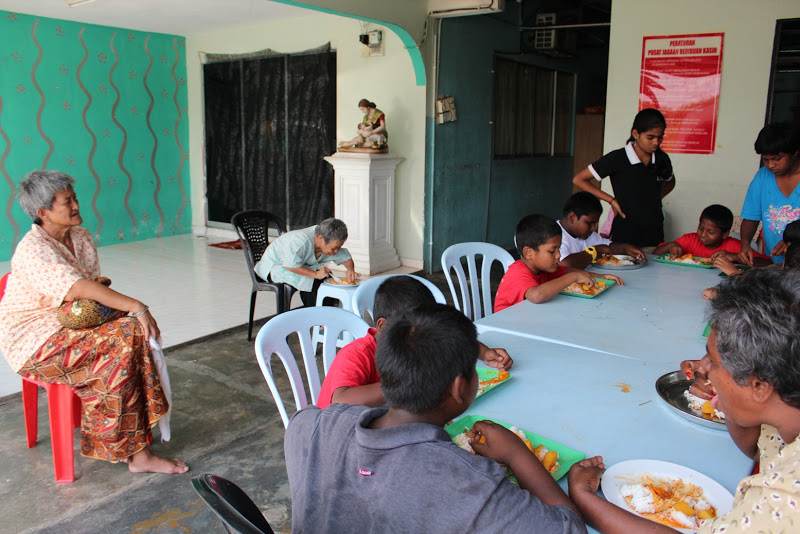
Sadly, the home is very small and the space is very congested, there is only 2 rooms (one for the female orphans and one for the elderly), the male orphans have to sleep in the study area area next to the car porch area in the night, and their dining area is actually an outdoor area where the elderly are sitting there most of the time.

The orphans are very independent, they cook by themselves and they can even serve and take care of the elderly. During the lunch time, the children let the elderly to eat first because there is not enough tables and chairs for everyone to eat together. This shows that they have manners and they show respect to the elderly. They also do not forget to pray before eating. They have only curry potatoes and eggs for lunch and they said it is enough and very delicious.

There are actually many problems in the home but most of them are satisfied with it. Yet I'm much more better than them in terms of my living condition yet I always complain about life. I've to learn from them, appreciate what I have and try to adapt to the environment but not asking for more.

Before I leave, I gave RM20 for them to buy more vegetables. This is a very meaningful experience where I can learn about life.

The middle girl is the 18 years old girl I mentioned who in charge of cooking for everyone in the house. She is very helpful and friendly.

This is the Study area with only a few old tables and chairs. At night, this area will turn into a public sleeping area for the boys.
 

This is the room for the elderly, one of them is folding clothes on the floor.


The living area.


Outdoor area where they hang their clothes.

Car Porch area turns into an open air dining area.

The Main Door to enter the home.

The entrance (left) and the dining area (right)

An example to show the integration of elderly and children having meals together


Monday, 19 November 2012

2.0 Background of Social Welfare Architecture in Malaysia


2.0 Background of Social Welfare Architecture in Malaysia
There are hundreds of thousands of orphans in Malaysia and it is estimated more than 40 thousand orphans require assistance and live a better life. There are hundreds of orphanages in our country, some are registered and some are not. The actual number of orphanages cannot be estimated accurately[1]. However orphanages are always insufficient to accommodate the large number of orphans all the time. On the other hand, Minister of Women, Family and Community Development Datuk Dr Ng Yen Yen said that the number of senior citizens aged 60 and above is increasing rapidly in these recent years in our country due to declining of birth rate and the improvement of health services. This indirectly increase the number of elderly living in old folks home as well.
From the survey that have been done, it shows that 76% of the people in Malaysia agree that the main problem faced by most of the private social welfare homes is the funding problem as they are not funded by the government. Apart from that, interviews with the person-in-charge in these homes were also carried out. For the private homes, their major financial income comes from donation from the public. Most of them are located at the residential areas, which the house is donated by some enthusiastic people. It is important to ensure the quality of life, the care received, the environment surrounding and the medical and education received by the old folks and orphans by providing the best care, facilities and services for them.
2.1 Living Lifestyle in Kuala Lumpur
The living lifestyle in Kuala Lumpur is very busy and the living status is very high as it is the main city of Malaysia. Most of the youngsters are working from morning till late evening in order to keep up with the cost of living. As a result, they have not enough time to take care of their old parents and their young children. For those who are financially stable, they have the choice to hire maids or send their family members to day care homes but for those who have financial problem they have no choice but to send them to old folks home or orphanage. There is a large number of elderly and children being abandoned in Kuala Lumpur.
2.2 Importance & Role of social welfare architecture to the society
Social welfare architecture plays a very important role to the society as they are the shelter for the abandoned or outcasts. Moreover, the living condition of these homes will reflect the attitude and moral values of the society.

Sunday, 11 November 2012

Survey Questions to the Elderly in Chinese


请问你住这里多久了?____________           

(1很赞同 2赞同 3中立 4不赞同 5很不赞同)
住宿环境
1
2
3
4
5
1. 这是个舒适的环境。


2. 这里的环境很卫生,打扫得很干净。


3. 这里的员工态度很好。


4. 这里有温馨的感觉 / 归属感。


5. 这里的空间适合我做各种活动。


6. 这里有足够的私人和公用的空间。


7. 这里的室内设计令人满意。(屋内)


8. 这里的外观设计令人满意。(屋外)


9. 这里的景观设计令人满意。(花草树木)


10. 这里的空间规划令人满意。


11. 这里是个很适合的地点。


12. 这里的室内有合适的气氛。


13. 这里的空气很流通,也有阳光。


14. 这里的设计使人方便。 (circulation)


15. 这里的设备很齐全。


16. 这里的设备维护 / 保持良好。


1. 你觉得住在这里有什么感觉?    
(可以选多过一个)
           舒服
           放松
           快乐
           安全感
           归属感
           闷
           寂寞
           没有安全感
           其他: _________________________

2. 住在这里有面对什么问题?
(可以选多过一个)
           寂寞
           环境不卫生
           缺乏私人空间
           缺乏活动参与
           缺乏交流
           空间狭窄
           缺乏小孩的陪伴
           其他: _________________________


改善环境
是
不
1. 你比较喜欢更舒服的环境?


2. 你比较喜欢空间更大的环境?


3. 你需要更多的私人空间吗?


4. 你需要更多的公用空间吗?


5. 你想要比较好的室内设计吗?(屋内)


6. 你想要比较好的外观设计吗?(屋外)


7. 你想要比较好的景观设计吗?(花草树木)


8. 你想参与多一点活动吗?


9. 你需要更多不同的空间来进行这些活动吗?


10. 你需要比较通风的环境吗?


11. 你希望这里有一个花园吗?


12. 你需要更好的设备吗?


13. 你觉得老人院应该比较靠近树林吗?


 [结合老人院和孤儿院]
1. 你赞同以上建议吗?  赞同 / 不赞同
2. 为什么? ___________________________________________________________________


3. 好处:(可以选多过一个)
           更多的乐趣 / 欢乐
           更多的快乐
           更多的沟通
           更多的爱与关怀
           觉得自己更有用
           更多活动参与
           可以得到尊重
           经验分享
           互相学习          
           其他: _________________________

4. 坏处:(可以选多过一个)
           没有私人空间
           吵杂
           累
           传播疾病
           缺乏空间
           沟通问题
           不方便
           其他: ____________________